
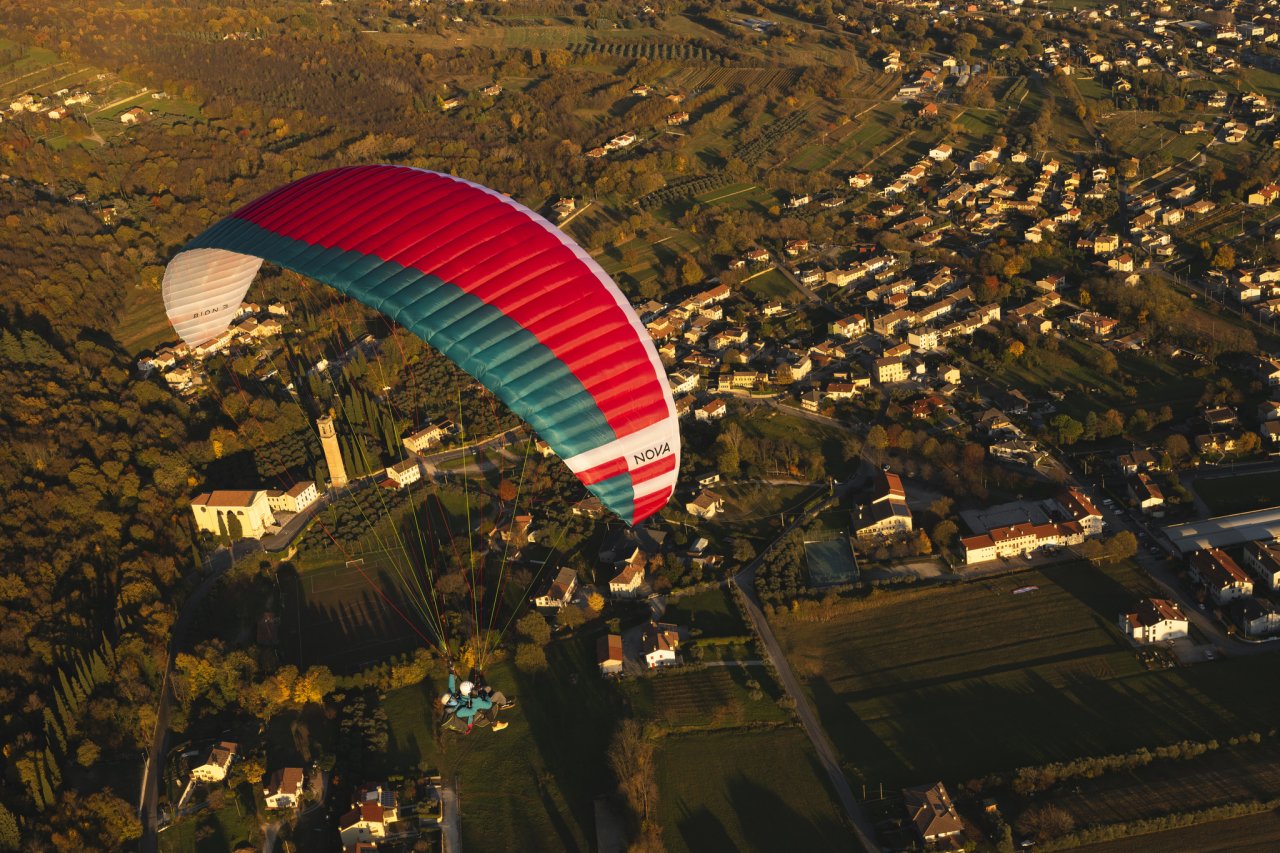
The NOVA BION 3 is a newly launched EN/LTF B certified tandem paraglider that blends lightweight construction with a robust, performance-driven design. Targeting professional tandem pilots and leisure pilots alike, it emphasizes ease of use, durability, and adaptability for thermalling and cross-country (XC) tandem flights. Its 34.5 m² projected area supports a wide takeoff weight range from 110 to 220 kg, with paramotor certification up to 250 kg, making it a flexible choice for various pilot and passenger combinations.
At its core, the BION 3 follows the principle of “as light as possible, as strong as necessary.” The size L wing weighs approximately 6.8 kg, which is notably light for a commercial tandem paraglider designed with full features. NOVA achieves this through strategic use of lighter fabrics where loads are minimal and durable cloths reinforcing high-stress zones, which results in long-term durability without compromising on handling or safety. This thoughtful material allocation is important for professionals who rely on their equipment daily.
Launch and Landing Performance
The BION 3 excels in launch and landing characteristics, a critical aspect for tandem operations. The wing inflates cleanly and predictably across diverse terrains and wind conditions with a notably low lift-off speed. This makes takeoff manageable and efficient for commercial tandem pilots repeatedly launching throughout the day as well as for leisure flyers seeking forgiving handling. On landing, it offers strong flare control allowing soft, well-managed touchdowns even when there is little to no wind, a key safety and comfort factor.
In-flight Handling and Weight Range Adaptability
The wing’s handling is finely tuned to deliver consistent performance throughout its broad certified weight spectrum. At lower wing loadings, the BION 3 is agile with a wide usable speed range while maintaining high stability, ideal for lighter pilot-passenger weights or relaxed soaring. At heavier loadings, which occur with added passenger or gear weight, brake pressure remains moderate and the takeoff and landing speeds remain low, ensuring consistent safety and comfort. This flexibility is essential for commercial pilots who often encounter varied passenger weights daily.
Thermal and Cross-Country Performance
Handling strikes a balance between comfort and performance. With trimmers closed, the wing is optimized for thermal flying, climbing efficiently with precise yet manageable brake responses and comfortable turns essential for tandem thermalling. Opening the trimmers reveals a high top speed and excellent glide performance, facilitating efficient transitions and wind penetration—beneficial for XC tandems or stronger valley wind scenarios.
Ergonomics and Pilot Workload
Pilot ergonomics receive practical attention, featuring 20 mm risers equipped with Fidlock magnetic buckles for tidying brake handles and trimmer straps, keeping the cockpit organized. An integrated clamp helps hold the A3 main line during Big Ears maneuvers, reducing pilot effort on prolonged descents. The wing’s compact packing volume and lightweight structure ease physical strain during repeated carry-ups and pack-downs. A minimalist, roomy pack sack enhances rapid packing in busy commercial environments.
Technical Design and Materials
Technically, the BION 3 incorporates established NOVA technologies: Double 3D Shaping at the nose reduces leading-edge creasing, improving profile fidelity which enhances glide and stability. Smart Cells adjust cell widths in response to load, producing a calmer canopy and aerodynamic efficiency. Its moderate flat aspect ratio of about 5.3 supports passive safety, reducing cravat tendencies and easing brake travel, yet internal structures and line layouts ensure competitive glide and speed.
The line system uses a reduced 3-line layout with shortened total line length, improving performance and collapse resistance. Design choices aim to minimize affected areas during collapses, lending better manageability and recovery. Materials include Dominico cloth on leading edges and top and bottom surfaces, Skytex 40 for profiles, and robust lines from Liros/Edelrid. Kevlar 20 mm risers offer strength with controlled stretch, underlining durability.
Support and Service
NOVA provides a supportive service ecosystem, including trim tuning post-initial use to account for line stretch and shrinkage, and comprehensive servicing at extended intervals. This maintains trim integrity, certified flight behavior, and wing longevity—particularly advantageous for commercial operators sensitive to long-term cost and safety.
Customer Feedback and Market Position
As a recent product launched in spring 2025, independent user reviews are scarce. Most available feedback is from NOVA’s materials, test pilots, and dealers, emphasizing the wing’s ease of launch and landing, wide weight handling, lightweight durability, and comfortable in-flight handling. These consistent professional endorsements underscore its position as a modern, versatile tandem wing suitable for commercial tandem schools, guides, and private pilots flying frequently with family and friends.
Potential buyers should note the lack of extensive independent, long-term durability reviews at this stage. The wing’s EN/LTF B certification and moderate aspect ratio ensure safe yet performance-oriented behavior, which may be more suitable for experienced tandem pilots than absolute beginners.
Conclusion
Overall, the NOVA BION 3 combines lightweight, durable construction with a wide performance envelope, easy handling, and pilot-friendly ergonomics. It stands out as a reliable tandem paraglider optimized for the demands of daily commercial use and enjoyable for leisure flying. Pilots looking for an accessible, robust wing with modern materials and design will find the BION 3 a compelling choice.
For more detailed information, visit the manufacturer's website and order your equipment with confidence at Paragliding.me.