
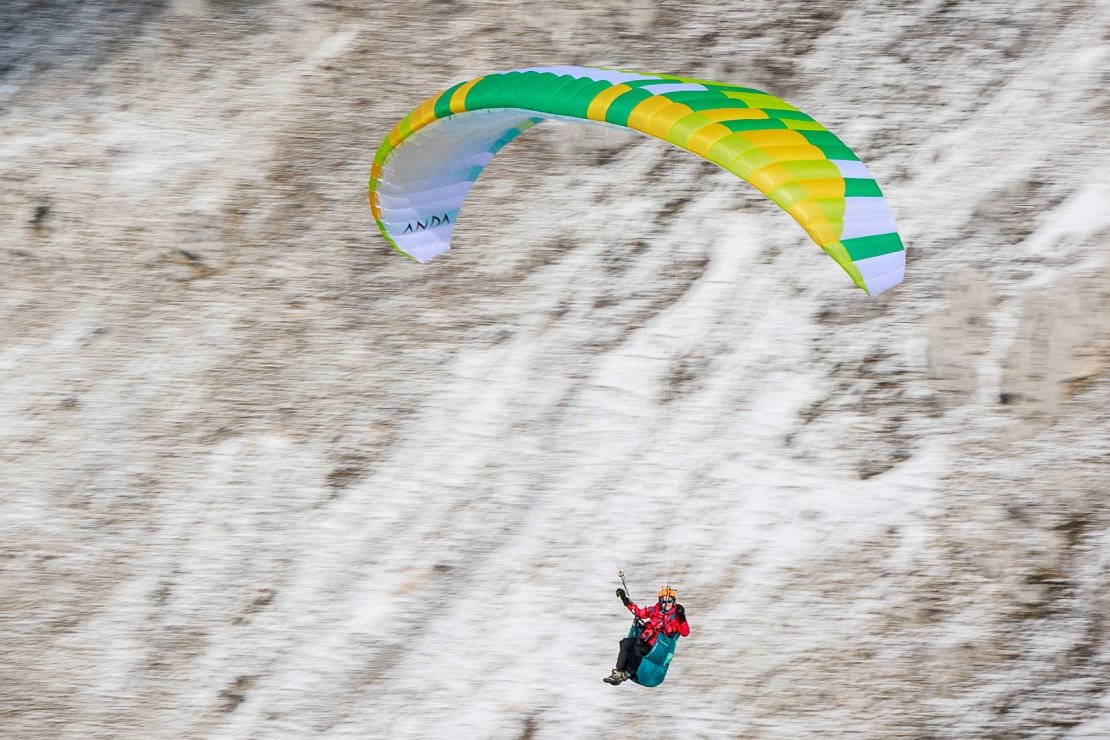
The BGD Anda EN/LTF-A paraglider is a carefully designed lightweight wing that targets hike-and-fly pilots, travelers, and newer pilots who seek a safe and capable glider. Weighing between 2.78 and 3.54 kg across five size options (XS to L), the Anda excels with its low weight, a compact pack size easily carried in hiking packs or as airline hand luggage, and straightforward launch behaviour. Its materials strike a balance between durability and lightness using double-coated Porcher Skytex 27 cloth, reinforced leading edges, weight-optimised ribs, and Kevlar/Dyneema lines and risers, requiring careful but practical handling typical of lightweight wings.
Performance and Handling
Sporting a modest aspect ratio of 4.8, the Anda delivers a best-glide ratio of about 9 and trim/top speeds around 38 km/h and 50 km/h respectively. This positions it on the higher end of EN-A performance, making it suitable for short cross-country flights, mountain transitions, or extended soaring in mild conditions. While it cannot match higher-class wings on glide, speed, or penetration, its “surprisingly good glide” provides more landing options and confidence in limited landing zones. Handling is described as both fun and forgiving: in the standard weight range the glider offers good sink rate and thermal climbing ability with predictable turns, while in the extended weight range it becomes more dynamic, faster, and better in stronger winds, albeit with less float in weak lift.
Launch and Ground Behavior
One of the Anda’s standout features is its easy and forgiving launch behaviour. Pilots report that the wing inflates effortlessly even in light or crosswinds and holds overhead reliably without overshooting, making take-offs stress-free on small or difficult mountain launch sites. Its low stall speed and progressive brake pressure ensure clear feedback before any stall, allowing even low-hour pilots to gain confidence. These launch characteristics are widely praised and considered a key selling point.
Design Innovations and Safety Features
BGD has incorporated advanced design elements such as Chord Cut Billow for cleaner leading edges and better internal pressure, triple-finger diagonals and an integrated line layout for structural integrity while minimizing lines, and progressive stability with a solid center and softer, more reactive tips. These technologies enable a compact, coherent wing that communicates air movements clearly yet calmly, helping maintain low pilot workload and predictable reactions. The wing also features softlinks to reduce weight, Kevlar 12mm risers with padded handles, and magnetic snap-lock brake attachments for user-friendly handling. The unsheathed Edelrid Pro Dry Kevlar lines contribute to drag reduction but require careful ground handling.
Target Pilots and Use Cases
The Anda is targeted primarily at beginners who desire a safe first wing with hike-and-fly capability, as well as experienced pilots seeking a lightweight, compact adventure wing with high passive safety. It is not intended as a performance mini- or speedwing, focusing instead on maintaining trusted EN-A characteristics while reducing weight and volume for mobility. Its adaptable weight ranges offer versatility, but pilots must understand the changes in handling when flying at higher wing loadings.
Customer and Pilot Feedback
Overall Impressions
Pilots and dealers consistently describe the Anda as a very safe, forgiving EN-A wing ideal for hike-and-fly and travel-oriented beginners or as a reliable mountain wing for experienced pilots who value weight savings and simplicity. Customers emphasize the wing’s launch ease, stability, and compactness as primary strengths.
Flight Characteristics and Safety
User feedback praises the Anda’s calm pitch and roll stability, gradual brake pressure with stall warning, and quick recovery from collapses typical of EN-A wings. Its thermaling performance in standard weight ranges is buoyant and predictable, supporting flat, easy turns in weak lift. Pilots flying heavier report the wing feels more dynamic and faster, suiting rapid descents and stronger winds, though less ideal for novices in mild conditions.
Performance
Reviewers note glide and speed are impressive for a low aspect ratio EN-A wing, making modest cross-country flights feasible. However, the Anda is not designed for ambitious XC pilots seeking to maximize distance or speed, who should consider higher class gliders.
Handling and Fun Factor
The handling is generally described as pleasantly light and progressive, with enough liveliness to enjoy thermaling and soaring while maintaining a large safety margin. Some advanced pilots find it less responsive compared to sportier EN-B wings, reflecting its design trade-off toward passive safety.
Weight, Packability, and Durability
Pilots universally appreciate the low weight and very compact packing size, which facilitates hiking and travel. The use of lightweight materials is balanced with durability considerations, with no widespread issues reported so far, provided the wing is treated sensibly to avoid abrasion or rough ground handling.
Hardware and Usability
The simple Kevlar risers, magnetic snap-lock brake attachments, and softlinks aid user-friendliness and weight reduction. While softlinks may require some adaptation for beginners used to conventional metal connectors, they are generally accepted and praised by the lightweight pilot community.
Limitations and Drawbacks
- Lightweight fabrics and unsheathed lines require more careful handling than standard school gliders and are less suited for rough training use or abrasive launch sites.
- Performance is modest, with best glide near 9 and limited top speed, so it will be outperformed in strong headwinds or ambitious XC by higher-class wings.
- The extended weight range increases dynamic reactions and speed, possibly diminishing climb performance and thermal float, which is not ideal for low-hour pilots.
- Softlinks and unsheathed lines might present learning curves in setup and maintenance for absolute beginners or schools.
Conclusion
In summary, the BGD Anda EN/LTF-A paraglider represents a refined lightweight EN-A wing combining exceptional launch behaviour, high passive safety, compactness, and surprisingly capable performance for its class. It is particularly well-suited to European hike-and-fly, mountain adventures, and travel enthusiasts, offering versatility with its dual weight ranges. While it is not a high-performance XC wing or training workhorse, its thoughtful design and pilot-friendly characteristics make it a compelling choice for careful beginners and lightweight-focused experienced pilots alike.
For more details and to explore the full specifications or place an order, please visit the manufacturer's website and order your equipment conveniently through Paragliding4.me.