
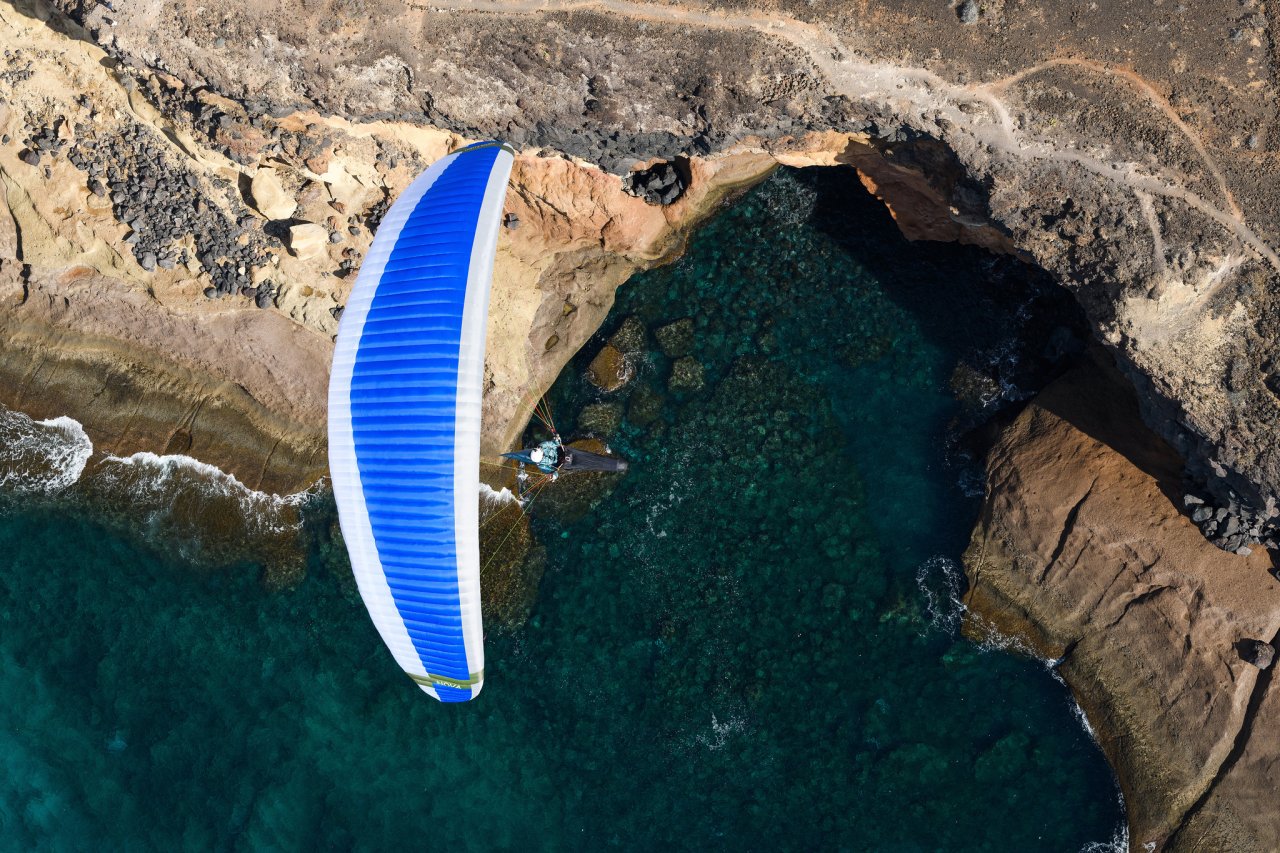
The NOVA MENTOR 7 Light – Hybrid 2.5-liner is a sophisticated cross-country (XC) paraglider designed for experienced EN/LTF B class pilots who seek a blend of high performance and manageable handling. Combining innovative hybrid line technology with lightweight materials, this wing pushes the envelope in the EN-B category with a 66-cell wing structure, a moderate aspect ratio of 5.5, and a notably low weight starting at just 3.65 kg for the XXS size. Its design prioritizes “actually usable performance,” offering XC pilots a capable machine that excels especially at speed while remaining accessible to competent B-class pilots.
Design and Construction
The Mentor 7 Light represents a complete redesign from earlier Mentor models, incorporating lessons from NOVA’s two-liner XENON. Its hybrid 2.5-liner configuration features a three-liner setup on the central part of the wing and a two-liner arrangement on the outer sections, effectively eliminating the outer C3 line. This layout enhances glide and top speed while retaining stability in turbulent, accelerated flight. The internal structure is notably complex, reinforced by rods and using durable, lightweight fabrics such as Porcher Skytex 27/38, which maintain both robustness and low pack volume — ideal for hike-and-fly pilots. However, due to the rod reinforcement, NOVA advises pilots to fold the wing carefully using the supplied pack roll or concertina bag rather than loose stuffing, trading ease of packing for superior performance and longevity.
Handling Characteristics
Launch and Ground Handling
Pilots and reviewers consistently report that the MENTOR 7 Light inflates smoothly and predictably, with gentle and stable behavior at launch even in strong or crosswind conditions. The wing’s lack of an outer C3 line changes ground handling dynamics: while C-risers effectively “kill” the wing to prevent inflation, asymmetrical control using the C-lines is weaker, so lateral corrections are more efficiently performed using the brakes. The hybrid line layout demands an adjusted technique, such as favoring B3-stall maneuvers over traditional big ears for descent.
In-Flight Handling
In flight, the wing offers precise brake control with moderate travel and a forgiving feel, enabling pilots to thermal effectively without nervousness or twitchiness. Its pitch stability in thermals reduces pilot fatigue by preventing sudden dives or oscillations, making coreing lift in challenging air more manageable. The wing is often described as sporty yet not excessively nervous, offering smooth and comfortable handling while providing ample feedback.
Performance and Cross-Country Suitability
The Mentor 7 Light is widely recognized as a major step up in XC performance compared to its predecessors, especially in the EN-B category. Its speed-optimized profile and careful load distribution allow for excellent glide ratios at full speed bar and superior top speed, rivaling some EN-C wings in real conditions. Reviewers emphasize the wing’s “real erfliegbare Leistung” or truly flyable performance — meaning that the enhanced capabilities are usable by competent XC pilots, not just elites. Competition successes reinforce the wing's reputation as one of the strongest EN-B XC gliders available.
XC pilots appreciate that the wing handles turbulent air confidently while maintaining internal pressure and form, reducing mental and physical strain on long flights. This capability is essential for rough alpine conditions or strong thermals where stability and speed are critical.
Safety and Stability
Safety-wise, the Mentor 7 Light maintains a solid, stable profile in accelerated flight, with milder accelerated collapse behavior than its predecessor, the Mentor 6. Test pilots and customers alike report that it feels "benign for its performance level," quickly building trust even in challenging conditions. However, it remains a high-end EN-B wing, often labeled EN-B+, and is recommended only for pilots with substantial experience on standard EN-B wings and good active flying skills. It is explicitly not a beginner’s glider.
Innovative Riser System and HAC C-Handles
A standout feature of the Mentor 7 Light is the Speedbrake Riser 2.0 system equipped with HAC (Height Adjustable C-Handles). These handlebars enable two-liner-style pitch and glide control on the speed bar. While this adds slight complexity, pilots once accustomed find it intuitive and a significant advantage, allowing them to stay accelerated longer and manage turbulence and surges more effectively. The riser setup includes a movable “baby-B” line and requires a short learning phase to master B3-stall technique and C-handle usage. For XC-focused pilots, the performance benefits outweigh the initial complexity and packing considerations.
Weight, Durability, and Packing
The ‘Light’ designation signals a focus on weight reduction, achieved without compromising durability. The use of high-quality lightweight materials ensures a wing that inflates quicker and feels livelier, yet isn’t overly fragile or twitchy. The pack weight varies between about 3.7 to 4.6 kg depending on size, striking a good balance for hike-and-fly or vol-biv pilots seeking performance and reliability. The rod-reinforced internal framework demands careful concertina packing to preserve shape and longevity, eschewing the easy, casual stuff packing common in lighter wings.
Target Pilot Profile
The Mentor 7 Light best suits active and experienced EN-B pilots aiming to elevate their cross-country game within the B category. Its combination of advanced performance features and safety characteristics make it ideal for those ready to learn or already adept at speed bar and C-steering techniques. Hike-and-fly and vol-biv pilots valuing XC capability in a lightweight package will find this wing a top contender. It’s less suited to low-hour pilots or those uninterested in mastering bar-and-C control or careful packing routines; for them, a simpler EN-B wing or the heavier Mentor 7 variant might be preferable.
Conclusion
In summary, the NOVA MENTOR 7 Light – Hybrid 2.5-liner is a finely tuned, high-performance EN-B XC glider that offers outstanding real-world flying qualities and top-tier speed for its class. It balances lightweight construction with robust durability, features innovative risers for enhanced flight control, and retains a comfort and safety level suitable for experienced B-class pilots. While the wing does require a learning curve and more meticulous packing, these are reasonable trade-offs for pilots seeking a trusted, fast, and stable machine to advance their cross-country flying.
For those interested in exploring further, you can find more details on the manufacturer's website. To order your MENTOR 7 Light or other paragliding equipment, visit Paragliding.me for expert advice and service.