

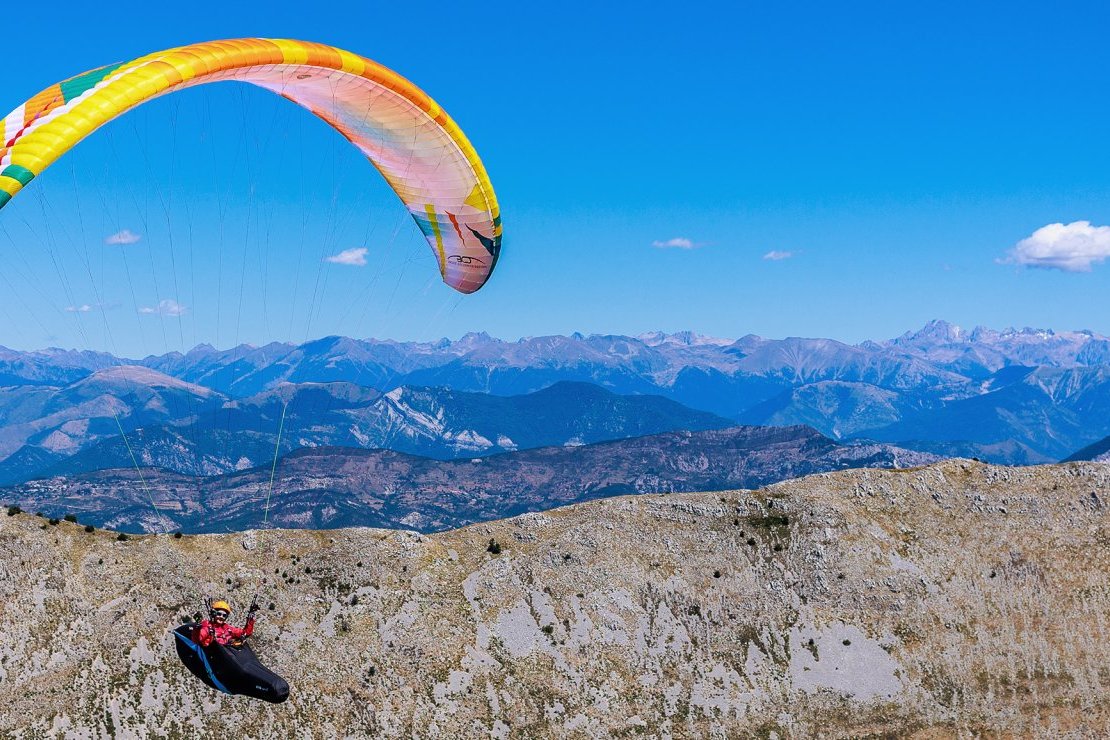
The BGD Lynx 2 – EN C Lightweight Cross-Country Paraglider represents a compelling choice for experienced pilots seeking a high-performance wing that balances comfort, safety, and practical durability. Designed with a hybrid 2.5-liner structure—three-liner in the center and two-liner at the tips—the Lynx 2 provides much of the speed, glide efficiency, and rear-riser authority characteristic of modern two-liners, while retaining the forgiving stall behavior and extended brake range of three-liners. This innovative design positions the Lynx 2 as a uniquely accessible yet performance-oriented wing within the EN-C category, ideal for cross-country (XC) and hike-and-fly pilots who want reliability without the usual complexity or fragility of high-end models.
Design and Construction
Featuring 65 cells and a flat aspect ratio of 6.2, the Lynx 2 sits at the higher end of EN-C performance without venturing into the demanding territory of full race wings. Its trim speed is about 39 km/h, with a top speed close to 58 km/h and a best glide ratio near 11 to 1—parameters that align well with contemporary EN-C cross-country wings. Its lightweight build, ranging from 3.2 to 4.3 kilograms depending on size, is achieved through a thoughtful use of Porcher Skytex 27 and 32 g/m² cloths, reinforced on the leading edge to resist abrasion on rugged mountain launches. The wing easily packs down small thanks to short leading-edge plastic rods, making it highly suitable for alpine adventure flying.
Launch and Ground Handling
Pilot feedback consistently praises the Lynx 2 for its remarkably easy and predictable launch characteristics. Described as one of the easiest wings to launch in the C category, it inflates smoothly and progressively without a sudden overshoot or stickiness, even in gusty or light wind conditions. Ground handling benefits from the wing's lightweight fabric and reduced line count, providing confident overhead control without twitchiness, especially important at smaller or technical takeoff sites.
In-Flight Handling and Comfort
Once airborne, pilots note the Lynx 2’s light, reactive, yet precise brake controls, accompanied by a broad brake travel that offers significant slow-flight margin. Turns are well-banked and progressive, tuned more towards efficient cross-country flying than acrobatics. The wing communicates air conditions clearly without nervousness, providing comfort on long XC flights by reducing pilot fatigue. Thermalling performance is strong, with the wing climbing well in smooth, efficient circles, especially when loaded near the top of its weight range.
Performance and Cross-Country Suitability
The Lynx 2 achieves near two-liner speeds with the ease of a three-liner, allowing bar speeds of 14–15 km/h above trim without severe pitch instability. Its glide performance competes well against current EN-C two-liners, supporting ambitious cross-country goals. The integrated rear-riser speed system works effectively, though some pilots accustomed to two-liner style handles find the foam-covered "speed riser" section less crisp. Overall, it is ideal for XC, vol-bivouac, and hike-and-fly racers who want to capitalize on a stable, efficient wing that lets them focus on tactical flying instead of constant active control.
Safety and Behaviour in Turbulence
The Lynx 2 is often described as an “easy C” due to its reassuring safety profile. Collapse behavior is tame, with smooth recovery characteristics and minimal nasty surprises reported even in challenging lee conditions. The wing offers solid early warnings through brake pressure, allowing pilots to anticipate and prevent collapses. Descent methods like big ears, spirals, and wingovers are reported as straightforward and manageable, while the long brake travel before stall aids in gentle spot and top landings—crucial for mountainous or confined landing zones. A Spiral Safety System further enhances stability by facilitating natural recovery from deep spirals, reducing the risk of dangerous lock-ins.
Weight, Packing, and Durability
With weights ranging from 3.2 to 4.3 kilograms across sizes, the Lynx 2 is among the lightest EN-C paragliders available without sacrificing durability. The use of 27 g/m² and 32 g/m² Porcher Skytex balances mission-critical wear resistance and weight savings, reinforced at the leading edge for mountain use. Kevlar-reinforced 12 mm riser webbing offers robust and easy handling, favored by pilots who prioritize practicality over minimal gram counts. The wing packs down exceptionally small, meeting the needs of hike-and-fly pilots seeking compact gear for long approaches and overnight bivouacs.
Ergonomics: Risers, Lines, and Cockpit Setup
The riser design features a unique foam-covered speed riser instead of rigid rear-riser handles, catering to simplicity and tangle-free operation. While some pilots prefer the tactile feedback of traditional hard handles, others appreciate the integrated, clean system. Lines are unsheathed, primarily single-color red, which improves aerodynamics but requires disciplined line-checking routines, especially under poor lighting. The speed system employs Prusik loops rather than Brummel hooks, a somewhat unusual but effective choice favored for security once correctly set up. Brake handles impress with padded comfort, magnetic keepers, and swivel design, elevating cockpit ergonomics over typical ultralight brakes.
Ideal Pilot Profile
This wing is best suited for experienced B-class pilots moving up to EN-C, XC enthusiasts seeking both high performance and handling forgiveness, and hike-and-fly or vol-biv travelers valuing light weight and robust construction. It is not recommended for beginners or pilots solely interested in maximum competition-level performance, due to its EN-C classification and pilot demands. The Lynx 2 shines for pilots who want real cross-country utility with manageable pilot workload and a focus on mountain adventure flying.
Summary of Strengths and Trade-offs
- Pros: Exceptionally easy launches, relaxed yet precise handling, competitive XC performance, lightweight and compact packing, strong safety with forgiving stall characteristics, high durability for a lightweight wing.
- Cons: Less tactile rear-riser control compared to two-liner style handles, unsheathed mostly single-color lines requiring careful pre-flight checks, still an EN-C wing demanding solid active-flying skills.
Overall, the BGD Lynx 2 offers a unique blend of two-liner performance and three-liner safety tailored to the real needs of Alpine XC and hike-and-fly pilots. It invites confident flying in demanding environments without burdening pilots with undue complexity or fragility.
For more detailed information, visit the manufacturer's website. You can also secure your equipment conveniently through Paragliding4.me.