

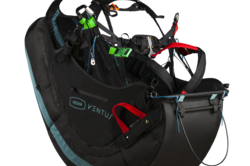
The NOVA VENTUS – free as the wind – is a modern, seatboard-style all-round paragliding harness designed for pilots who prioritise maximum passive safety and user-friendliness in a classic upright harness configuration rather than a pod style. Positioned as a versatile everyday harness, it suits training, local soaring, thermalling, and relaxed cross-country (XC) flying, rather than specialised hike-and-fly or competition pods.
Design and Safety Features
From a safety perspective, the NOVA VENTUS stands out with its robust dual-protector design. It combines a fully pre-inflated foam protector that offers immediate protection as soon as the harness is worn, with an additional viscoelastic SAS-TEC back protector situated in the upper back area. This double-layer system enhances impact distribution, particularly against hard or sharp objects stored in the rear compartment, thereby reducing spinal injury risks. The foam protector is compact for its category (approximately 18–20 cm in size M), delivering airbag-like protection without the delay or vulnerability associated with true airbags. Impact tests show a performance rating of 33 g, and the harness supports a certified maximum clip-in weight of 120 kg, aligning it with robust, school-capable harness standards.
Reserve parachute deployment is another area where the NOVA VENTUS excels. The reserve container is ergonomically optimised, with extensive in-house testing surpassing EN standards, including multi-directional deployments under high g-loads using a G-Force Trainer. This thorough testing caters to real-world scenarios where pilots may be in unusual positions or experiencing high g-forces when deploying the reserve. Additionally, the harness features T-Lock buckles that prevent leg loops from accidentally opening, serving as an important safety backup for forgetful pilots.
Comfort, Handling, and Practicality
The NOVA VENTUS is designed with pilot comfort and handling response as central goals. Its geometry and hang-point height aim to provide a stable yet responsive in-flight feel. The honeycomb seat plate combined with harness geometry offers good weight-shift authority and tactile feedback, even during dynamic maneuvers, while damping enough motion to be forgiving for less experienced pilots. The SAS-TEC back insert, padded Air Mesh backrest, and ventilated spine channel contribute to back support and thermal comfort, making it suitable for long flights.
Adjustability is a notable feature, with seat angle, shoulder straps, and chest strap all accessible and adjustable in flight, allowing pilots to fine-tune comfort and roll stability as conditions evolve. On the ground, the leg loops are cut to allow good freedom of movement, aiding takeoffs and ground handling.
Storage is practical and well thought out, including a main rear compartment with space for a hydration bladder and a routed drinking-tube channel, an auto-locking zip on the rear pocket to prevent accidental opening in flight, side zip pockets for essentials like phone or first aid, and a radio pocket with two possible mounting positions on the shoulder strap. Colour-coded buckles and attachment points mirror NOVA’s riser scheme (green right, red left), supporting intuitive setup and reducing pre-flight errors, especially helpful for students. The chest-strap buckle includes a whistle for emergencies. Carabiners and the speed system come pre-installed, making the harness ready to fly out of the box.
Sizing, Target Audience, and Certification
The harness comes in three sizes (S, M, L) covering a broad range of pilot heights. The small and large sizes are specifically shaped for smaller and larger pilots respectively, rather than just scaled versions. Weight varies between 4.25 and 5.0 kg depending on size, typical for a robust all-round harness with full foam protection. This weight class means the VENTUS is less suited for pilots focused on ultra-lightweight hike-and-fly gear. The harness is DHV certified (GS-03-0391-18), underpinning its role as a school-suitable, everyday harness rather than a niche product.
Customer and Pilot Feedback
Users and dealers consistently highlight the VENTUS’s exceptional passive safety. Its dual protection system is praised for providing immediate and comprehensive impact mitigation, valued especially during takeoff and ground handling incidents. The rigorous reserve deployment testing is reassuring for pilots facing real-world rescue scenarios. Comfort on long flights is often noted, with the supportive backrest and seat geometry contributing to an enjoyable all-day harness feel. The handling is described as stable but responsive, well-suited for thermalling and dynamic maneuvers without the nervousness typical of competition pods.
The harness’s intuitive setup with colour-coded buckles and the T-Lock closure system receives positive remarks for increasing safety and ease of use, especially for instructors and newer pilots. Practical features like multiple storage options and in-flight adjustable straps enhance its appeal for everyday flying.
Resale listings show that many pilots purchase the VENTUS during their training or early progression years, often selling it later when switching to specialized pods or lighter harnesses. Reports from second-hand owners indicate excellent durability, with most harnesses maintaining very good condition even after multiple seasons and handling no major crashes.
Limitations and Trade-offs
A notable trade-off with the NOVA VENTUS is its weight and pack volume due to the foam and SAS-TEC protection system. While the foam protector is compressible, it does not pack as compactly as airbag-only designs, making the harness bulkier than ultralight or pure airbag harnesses. Pilots prioritising hike-and-fly performance or minimal weight may find this a downside.
The VENTUS is not a pod harness and does not cater to pilots seeking maximum aerodynamic efficiency or pod-level XC performance. Its design prioritises comfort and safety over glide performance, so pilots often transition to pods as they advance their flying skills and ambitions.
Furthermore, it lacks some niche features such as integrated front reserves or compact reversible backpack systems found in specialized lightweight harnesses, positioning it as a solid, standard all-rounder rather than cutting-edge gear.
Conclusion: Who Should Choose the NOVA VENTUS?
Overall, the NOVA VENTUS harness is a well-rounded, safety-focused, and comfortable option for pilots seeking a reliable everyday harness. Its robust passive protection, user-friendly features, and stable yet responsive handling make it ideal for training, early progression, local flying, and moderate XC. Durability and thoughtful details add to its attractiveness for pilots valuing safety and comfort over lightweight or aerodynamic specialization.
Pilots who are weight-conscious, ultra-light hike-and-fly enthusiasts, or those seeking maximum aerodynamic advantage for competition might eventually outgrow the VENTUS. However, for most recreational pilots looking for a single harness that covers training, general flying, and XC with a high safety margin, the NOVA VENTUS represents a very solid and modern choice.
For more detailed specifications and to explore ordering options, visit the manufacturer's website. You can also conveniently order this equipment through Paragliding.me.