

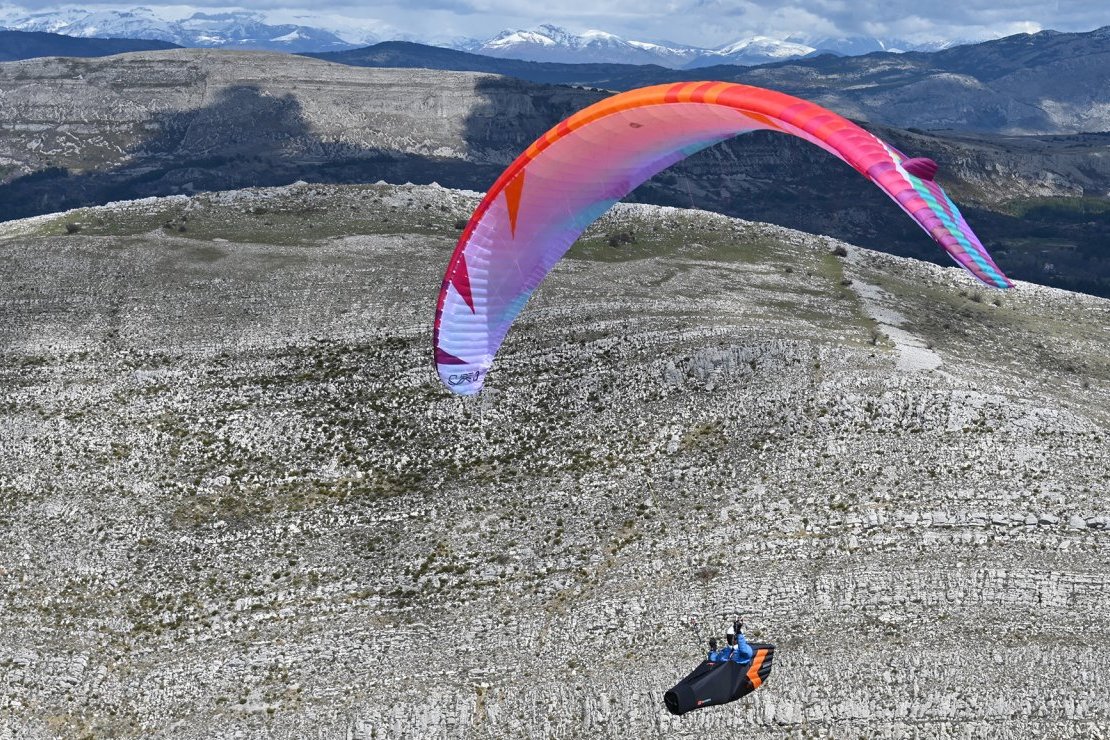
The BGD Cure 3 is a high-performance EN-C two-liner paraglider designed by Bruce Goldsmith Design (BGD) for experienced pilots who seek to excel in cross-country (XC) flights and serial-class racing. Combining advanced design features and cutting-edge technology adapted from BGD's competition and performance lines, such as the Diva 2 and Base 3, the Cure 3 stands out at the top of its EN-C category, offering a blend of impressive performance with commendable passive safety, clear feedback, and intuitive handling.
Performance and Design Excellence
The Cure 3 is engineered for pilots stepping into or staying within the modern high-end EN-C two-liner segment. It targets those who possess strong active flying skills and considerable XC experience but prefer not to commit to the more demanding full competition CCC/EN-D wings. Marketed as the “miracle cure” for pilots deeply passionate about XC, it is designed to enable long, fast flights often in challenging conditions.
From a technical standpoint, the Cure 3 is uncompromising:
- It features a high flat aspect ratio of 6.7 with 70 cells, optimized for superior glide and speed. The two-liner format with fewer and shorter lines minimizes drag, enhancing glide efficiency, especially when flying at full bar.
- Its reflex profile and progressive stability concept provide strong pitch and collapse resistance at speed. Concentrated lift near the leading edge and reflex behavior contribute to frontal collapse resistance, rendering the wing stable and solid when accelerated.
- Rear-riser control, enhanced by carbon rear-riser handles, plays a central role in enabling efficient and precise high-speed flying. This allows pilots to actively fly on bar without constant brake use, crucial for modern XC and race flying techniques.
- Design features such as raked swept-back wingtips, winglets, and maximized unsupported cells demonstrate the application of computational fluid dynamics (CFD) and structural optimization to reduce induced drag and refine spiral behavior. Winglets specifically contribute to benign spiral characteristics without sacrificing performance.
- The internal structure utilizes BGD’s Chord Cut Billow (CCB) technology to eliminate excess material and leading-edge wrinkling, maintaining a clean profile for enhanced performance and stability. Parasim, BGD’s in-house CFD/simulation tool, aids in tuning load distribution, stability progression, and handling before prototype construction.
Practical Flying Experience
BGD emphasizes that the Cure 3 offers both speed and fun. It boasts a very high top speed with strong stability when accelerated on bar, giving a “tightening-up” sensation that experienced pilots appreciate during long transitions. The handling is responsive and lively, with small brake inputs yielding immediate results. It excels in wide XC thermals with efficient, flat flying, and confidently banks up in strong, narrow cores for aggressive climbs.
The “never-landing feeling” described by the manufacturer reflects the wing’s ability to stay aloft in weak conditions, making it especially suited for ambitious XC tasks and racing scenarios where marginal glides are critical.
Sizing and Pilot Weight Range
The Cure 3 comes in four sizes—S, M, ML, and L—with flat wing areas ranging from 21 to 26.1 m². Pilot weight ranges cover approximately 73–84 kg for the S size up to 108–119 kg for the L. This broad spectrum allows pilots to fine-tune their flying experience by choosing to fly in the middle of the range for balanced performance or higher in the range for more dynamic handling and improved penetration.
The glider’s weight varies between 4.8 and 5.7 kg, which is competitive for a full-featured EN-C performance wing—neither ultra-light nor overly heavy—making it suitable for serious XC pilots and hike-and-fly adventures.
Materials and Construction Quality
The Cure 3 uses proven, conventional materials that balance durability with performance:
- Porcher Skytex fabrics (32 and 38 g/m²) cover the top and bottom surfaces, with hard-finish Skytex for internal structure reinforcement.
- Lines are unsheathed Edelrid Kevlar/Dyneema, optimizing line drag reduction while maintaining strength.
- Risers are made from Kevlar/nylon webbing with robust Riley/Sprenger hardware and pulleys, designed to withstand intensive XC and race usage.
Safety and Accessibility Considerations
The Cure 3 is explicitly targeted at pilots with considerable experience—those comfortable on higher-end EN-B or low-end EN-C three-liners seeking a step-up, as well as existing EN-C and EN-D pilots who desire a more manageable but still high-performing glider. Its progressive stability, characterized by a solid center and softer tips, coupled with the signature “BGD feedback,” provides pilots with clear air mass awareness to encourage proactive flying rather than turbulence masking.
The wing's LTF D certification (due to the collapse lines used) underlines that despite its EN-C classification, it is a high-energy aircraft requiring serious piloting respect.
Customer and Tester Insights
Pilot reviews consistently highlight the Cure 3 as a powerful “high-C” two-liner noted for its speed, pitch stability, and usability uncommon for its class. Testers praise its climb and glide, remarking on its cohesive and reassuring flight behavior in active, sporty air and when fully accelerated. Its “tightened-up” feeling at speed contributes to relaxed, efficient long XC transitions.
Handling emerges as one of the wing’s most admired features, with short brake travel, a clear stall point, agile and direct turning, and effective rear-riser bar control. In comparisons with other EN-C wings, the Cure 3 is often ranked near the top for thermalling and glide, with some pilots suggesting it offers performance close to higher-category wings while remaining more accessible and comfortable, especially when flown mid-weight.
On the downside, several reviewers note heavier brake forces beyond the initial few centimeters and a slower inflation on launch requiring firm input, though this is rewarded with stable and well-controlled takeoffs.
Summary
The BGD Cure 3 stands as a modern, technologically advanced EN-C two-liner tailored for ambitious XC pilots and serial-class racers. Its strengths lie in exceptional glide, top speed, efficient rear-riser control, refined handling, and robust pitch and collapse resistance. Unlike pure race wings, it offers a balanced, fun flying experience that prioritizes pilot engagement and confidence.
However, it demands solid piloting skills and familiarity with two-liner dynamics, making it unsuitable for cautious or low-hour pilots. Its materials and design favor performance over ruggedness or casual ease-of-use.
Overall, the Cure 3 is ideal for pilots who fly regularly, have a good understanding of air conditions, and seek to push long distances or compete seriously while staying within the EN-C category.
For more detailed information about the BGD Cure 3 and to explore its specifications further, please visit the manufacturer's website. To order the Cure 3 or other quality paragliding equipment, visit Paragliding.me.